
Thomson Reserve: Yes, or No?
Thomson Reserve has been the talk of the town for a while, but does it deserve the attention it’s getting?
With renowned developers, 1,268 homes and plenty of buzz, I understand the excitement. I like a fancy showflat as much as anyone, but I also like seeing the numbers first, which makes me less fun at launch events.
So here’s my two big questions: is this the right home for you, and does the price make sense?
Thomson Reserve at a Glance
CapitaLand Development, UOL Group and Singapore Land Group have teamed up on Thomson Reserve. Note that it isn’t every day that you see three legendary names on one project.
It’s a 99-year leasehold development at Bright Hill Drive with 1,268 homes, from two to five bedrooms, spread across four 21-storey towers and two 30-storey towers. The CDL page names Upper Thomson MRT as the nearest station, but Bright Hill MRT Station is almost the same distance away.
It’s still under development, which means at this time of writing, in October 2026, the developer’s page lists no prices or launch date, so everything about price below is “to be confirmed”.
The Location: What Daily Life Feels Like
In time-strapped Singapore, a good location is measured in everyday trips, like the daily walk to the MRT station, dinner, groceries, school drop-off and a patch of green to breathe in.
Ai Tong School sits on Bright Hill Drive itself, and several other schools are within reach. If your little one is entering Primary One, check the exact distance on the Ministry of Education’s SchoolFinder rather than trusting a brochure, since MOE sets the 1 km priority zone.
For food and shopping, there are the cafés and restaurants along Upper Thomson Road, plus the neighbourhood mall by the MRT station. And when you need space to breathe, the Upper Thomson Park Connector is a 0.8 km, wheelchair-accessible path alongside Lower Peirce Reservoir Park that leads on towards Thomson Nature Park.
In addition to Upper Thomson, Bright Hill MRT is also a short walk away and a planned Cross Island Line interchange, which means great connectivity in the 2030s.
The Development Itself
The developer says the towers are positioned to maximise views of the surrounding greenery, but the layout has yet to be released.
Here’s one number worth knowing. 1,268 homes across six towers is roughly 210 homes per tower on average. That’s a lot of neighbours sharing lifts, the pool and the gym at peak hours. Ask for the site plan and measure the gap between your block and the next to get an idea of how much space it will feel like.
Layouts and Unit Choices
If you’re thinking about buying, the next question is, which unit?
6 blocks. Different stacks, floors, facings. It all affects your view, your sun, even your resale price. Most buyers walk in on booking day and ask “which one is still available?”
The better question is “which one is right for me?”
I use a 3D map to compare every unit before booking day. Some frequent questions to ponder are:
- Is the view worth the premium?
- Morning or afternoon sun?
- Which layout suits own stay vs investment?
With two- to five-bedroom homes on offer, the best layout is the one that actually works for you and your family. Check usable space (will a king bed and wardrobe really fit?), where furniture can go, sunlight and facing, and whether anything could block your view later. West sun matters more than most buyers expect.
After thorough analysis (with you), we lock in your Plan A and Plan B. No rushing.
Price and Alternatives
Look at two numbers, not one. There’s the price per square foot (psf), and there’s the total price. A lower psf can still mean a hefty price if the home is larger.
Be wary of any “from” price you see before the official list is out, as it may be an agent’s estimate. Once the developer releases its price list, line it up against nearby new launches and resale homes. For resale and reported sales, URA’s free Property Market Information service lists transactions by project.
Next, ask what else your budget could get you. A smaller new home here, or a bigger resale home down the road?
Also, be sure to check your TDSR with your bank. Just a quick recap, this Total Debt Servicing Ratio is the share of your income that can go towards all debt repayments.
Strengths and Trade-Offs
Three strengths
- A direct link to Upper Thomson MRT – That means shorter daily trips and more time at home.
- A design built around greenery and views – It’s worth checking on site, since it shapes how the home feels day to day.
- Future connectivity – LTA lists Cross Island Line Phase 1 for 2030, with Bright Hill, also walking distance away, as an interchange. When connectivity is increased, prices typically are too.
Three trade-offs
- The development’s size – Many neighbours means busier shared spaces, and many similar homes competing when you sell.
- The wait – It’s still under development, so you’ll be living elsewhere until it’s ready.
- Price and facing – The price is still unconfirmed, and a west-facing stack can be hot in the afternoon.
In-Depth Analysis
If you are interested in the nitty-gritty details, here is a full analysis done by my team and I, which is how we arrived at our investment verdict.
Why I Might NOT Buy
1. Too many small units
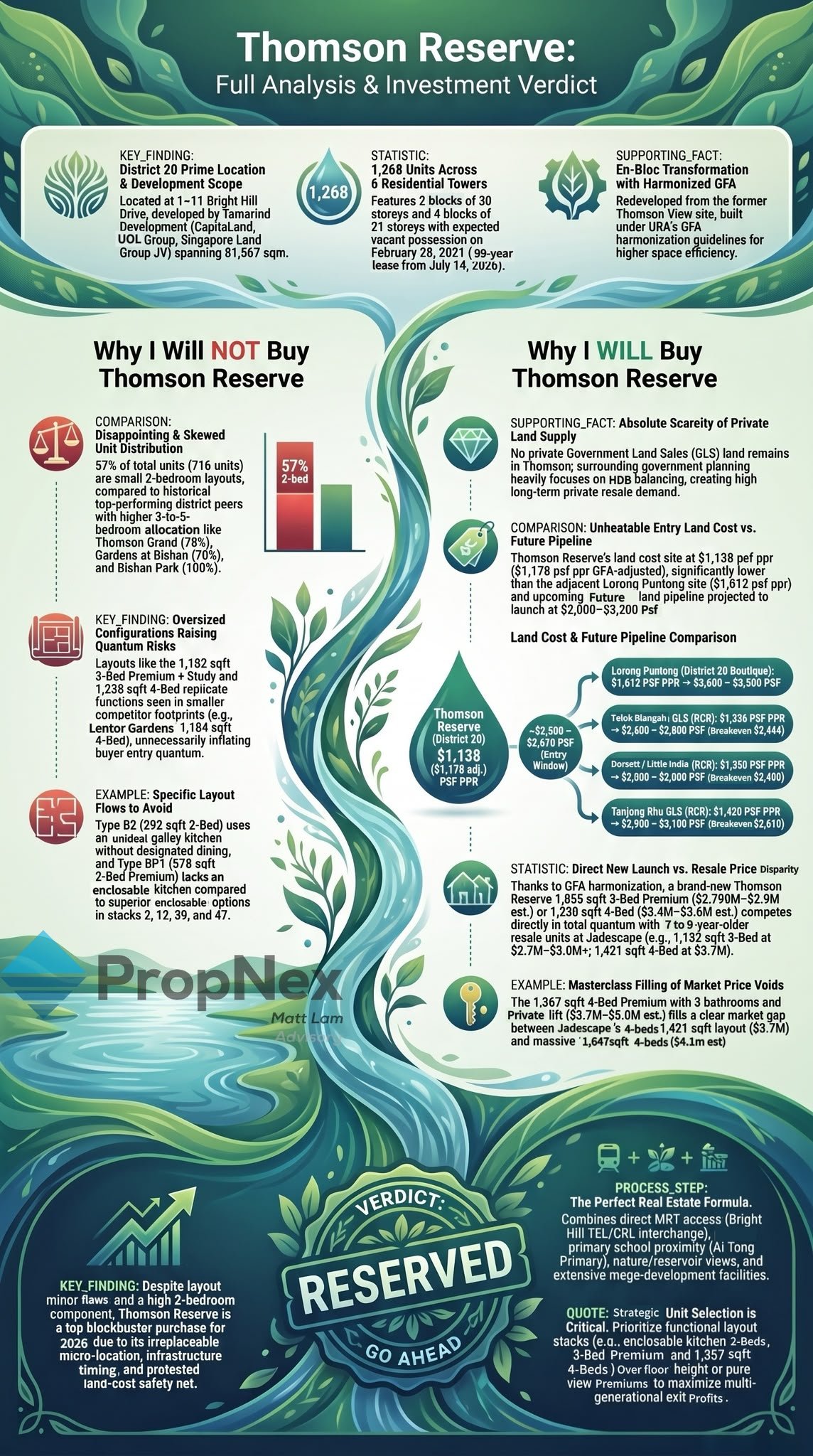
More than half the homes in this project are small. Of the 1,268 units, 716 (57%) have only one or two bedrooms. That leaves just 43% for bigger three, four and five-bedroom homes.
Why does that matter? Bigger homes suit families, and families tend to buy to live in and stay for years. That steady demand helps keep prices firm when it’s time to sell. Small units mostly attract investors and singles, so when lots of owners in the same block try to sell at once, they end up competing with each other on price.
You can see this pattern in District 20 (the Bishan and Thomson area). Projects with more family-sized homes have generally held their value better over the years.
| Project | Small units (1 to 2 bedrooms) | Family units (3+ bedrooms) | How it has done |
|---|---|---|---|
| Bishan Park | 0% | 100% | |
| Thomson Grand | 30% | 70% | One of the best |
| Gardens at Bishan | 30% | 70% | One of the best |
| AMO Residence | 49% | 51% | |
| Thomson Three | 51% | 49% | |
| Thomson Impressions | 60% | 40% | Average |
| This project | 57% | 43% |
2. Big layouts, big price tags
Some of Thomson Reserve’s layouts use more space than they need to, and you pay for every square foot.
The three-bedroom with study (1,152 sq ft) reuses an older layout with long corridors. At an expected S$2.9 to S$3.1 million, you’d be paying close to four-bedroom prices without getting a fourth bedroom.
The compact four-bedroom is 1,238 sq ft. Lentor Gardens offers a four-bedroom that works just as well in 1,184 sq ft, so it costs less overall.
Some buyers who waited over a year for Thomson Reserve’s compact four-bedroom found it beyond their budget and went elsewhere. Six of Lentor Gardens’ four-bedroom units sold in a single day, one of them to a client of mine.
3. Layouts
Not every unit in Thomson Reserve is laid out equally well.
The smaller units. Type B2 (592 sq ft, stack 8) and Type BP1 (678 sq ft, stacks 3 and 38) have open kitchens with no proper spot for a dining table. You also can’t close the kitchen off, so cooking smells and smoke spread into the living room. That’s fine for someone who rarely cooks, but harder for a family that does.
The afternoon sun. Block 7 faces north-west, so it gets the hot afternoon sun. That can mean warmer rooms and higher air-con bills. In fairness, Block 7 also has open views of nature and the reservoir, and many buyers are happy to trade a bit of heat for that. Skye at Holland is a similar case.
If you’re looking at any of these units, visit at different times of day and picture your daily routine in the space before deciding.
Why I Might Buy
1. Very little new land, and lots of demand
There’s no government land left for new private homes in the Thomson area. Once Thomson Reserve is sold, buyers here will have very few new condos to choose from.
Next door in Ang Mo Kio, the gap is even clearer. There are 49,883 HDB flats but only 4,020 private homes, so just 7% of homes are private. Many HDB families in the area who want to upgrade but stay close to family, school and work will have few options nearby.
Location helps too. Thomson Reserve sits right beside Bright Hill MRT station and within 1 km of Ai Tong Primary School, which is popular with parents.
It also costs less to build. Its land was bought at about S$1,138 per square foot of floor area. A smaller nearby site at Lorong Puntong sold for S$1,612, and homes there are expected to launch at S$3,000 to S$3,200 per square foot. Thomson Reserve should come in well below that.
2. A lower land price means a lower selling price
Every new condo starts with a piece of land, and what the developer pays for that land shapes the price they need to charge you.
Thomson Reserve’s developer bought its land when land prices were lower, at about S$1,138 per square foot of floor area they’re allowed to build. Since June 2025, land prices at government land sales have jumped by 20% to 40%.
That matters because developers who paid more for their land have to charge more for their homes, just to cover their costs. Here’s how the upcoming projects compare.
| Project | Area | Land cost (per sq ft) | Break-even price (per sq ft) | Expected launch price (per sq ft) |
|---|---|---|---|---|
| Thomson Reserve | Thomson | S$1,138 | Around S$2,650 | |
| Telok Blangah | City fringe | S$1,326 | S$2,444 | $2,700 to $2,800 |
| Dorsett / Little India | City fringe | S$1,338 | S$2,460 | $2,800 to $3,000 |
| Kallang Close | City fringe | S$2,564 | $2,800 to $3,000 | |
| Tanjong Rhu | City fringe | S$1,420 | S$2,619 | S$3,000+ |
| Dover Drive | City fringe | $3,000 to $3,200 | ||
| Newton | Prime | S$1,820 | Around S$4,000 |
A few terms explained
• Land cost is what the developer paid per square foot of floor area they can build.
• Break-even price is the lowest price the developer can sell at without making a loss.
• City fringe (RCR) covers areas just outside the city centre. Prime (CCR) is the city centre and prime districts. Suburban (OCR) is everything further out.
Thomson Reserve is expected to launch at around $2,650 psf. Many projects coming after it will likely start at $2,700, purely because the land on which they are built costs more.
In short, newer land costs more, so newer homes will likely cost more too. Thomson Reserve may be one of the last chances to buy in at an older, lower land price.
3. New homes at close to resale prices
New condos usually cost a lot more than resale ones nearby. At Thomson Reserve, the gap is smaller than you’d expect, and you often get a better layout. Here’s how it compares with Jadescape, a popular resale condo next door.
Two-bedroom with study. Thomson Reserve’s unit comes with a study and a kitchen you can close off, at an expected S$1.80 to S$1.86 million. Jadescape’s has neither, yet sells for S$1.66 to S$1.76 million.
Compact three-bedroom. Thomson Reserve’s fits a six-seater dining table and a queen bed in every bedroom. Jadescape’s similar unit fits neither, and still sells for S$2.25 to S$2.39 million.
Four-bedroom. Thomson Reserve’s is expected to cost S$100,000 to S$300,000 less than Jadescape’s nearest equivalent.
In short, you pay only a little more than resale, and sometimes less, for a brand-new home that uses its space better.
Wrapping It All Up
Who I’d shortlist it for
Families who want a train line, schools and green space close together, and who are happy to wait for completion. It also suits upgraders who like a big, well-run development with a wide choice of layouts.
Who might do better elsewhere
Buyers who need to move in soon, anyone who dislikes busy shared facilities, and those already stretching to afford it. A resale home nearby could give you more space for the same money, and you’d move in sooner.
The attractive price (to me)
Around the level of comparable nearby new launches, or a little below, once I’ve allowed for the longer wait.
If you’re weighing Thomson Reserve, give me a buzz. We’ll look through your numbers together and see whether it will suit your needs.