
Singapore Property Prices vs Interest Rates: What Does History Tell Us?
The love affair between property prices and interest rates is a long, drawn-out topic of great debate. Every time interest rates go up, the real estate market gets all worked up, and two main questions are at the forefront of everyone’s thoughts.
“Will property prices fall?”
“Should I wait until rates come down before I buy?”
I completely understand. Higher rates mean a bigger monthly mortgage and less you can borrow. If you’re sitting at the kitchen table trying to work out whether your family can afford the next move, that’s a very real worry.
But does a rate hike really mean prices will fall? Rather than guess what happens next, I find it far more useful to look at what has already happened.
What History Actually Shows
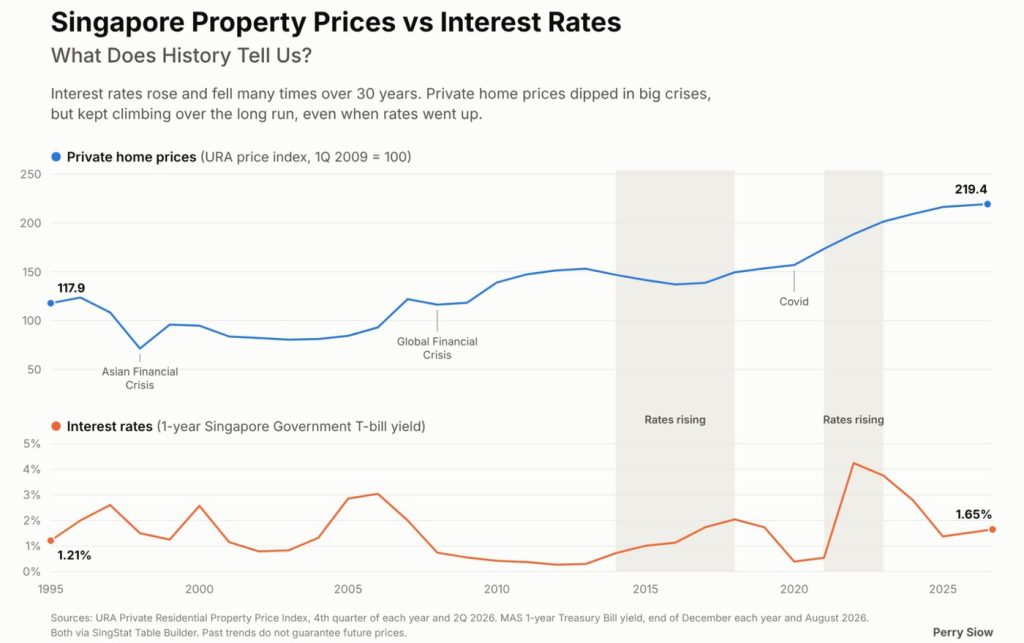
Over the past 30 years, Singapore has been through the Asian Financial Crisis, the Global Financial Crisis, Covid, long stretches of high interest rates and several rounds of rate hikes. During these big events, property prices DID correct, which is natural.
Step back and look at the longer term, though, and private property prices have kept trending upwards, through periods of both rising and falling rates. The climb hasn’t stopped recently either. URA’s flash estimate for the third quarter of 2026, released on 1 October 2026, shows private home prices rising 1.4% in that quarter.
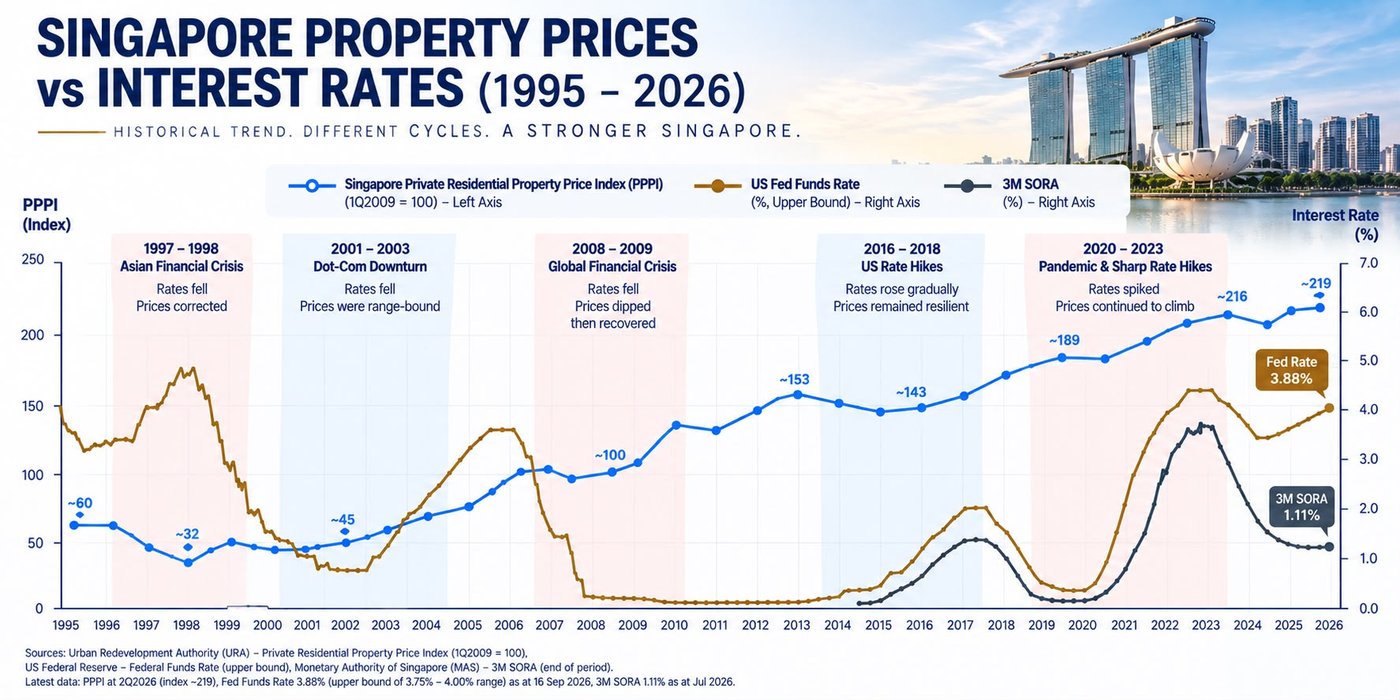
This chart makes one thing clear. Rates going up doesn’t automatically mean prices coming down. When rates rose sharply between 2015 and 2018, and again between 2022 and 2023, the market didn’t crash.
It slowed.
Buyers became more careful, and affordability got tighter, which is a very different story from a collapse.
So if interest rates are only part of the picture, what’s holding up the rest?
Three Factors Behind Singapore’s Property Market Resilience

1. People still need homes
This one is simple. A home isn’t only an investment. People buy because they’re getting married, starting a family, upgrading to more space, or right-sizing once the children have grown up. That creates a steady cycle of buying and selling that doesn’t switch off when rates climb.
Someone may put off a purchase for a year or two. But the need for a home doesn’t disappear, which is why I never look at housing demand through interest rates alone.
2. Population and households keep changing
I’m sure you’ve heard that Singapore has a low birth rate and an ageing population. At the same time, people keep coming here to work, and some become PRs and make Singapore home. As the number and make-up of households shift, so does the need for housing. The government’s Population in Brief 2025 tracks these trends each year and is a surprisingly easy read.
None of this means prices must always go up. Markets still correct when the economy turns. But there is an underlying need for homes that carries on long after any single rate cycle ends.
3. The market has safeguards built in
Cooling measures, TDSR and LTV limits can feel like hurdles when you’re trying to buy. In plain terms, TDSR (the Total Debt Servicing Ratio) caps how much of your monthly income can go towards all your loan repayments, and LTV (the Loan-to-Value limit) caps how much of the property price a bank can lend you. MAS explains the TDSR rules here, if you’d like the details.
These rules exist to stop people borrowing more than they can manage, and to keep speculation in check. A market with less excessive borrowing is better placed to handle a rise in rates. Nobody can promise there will never be a correction, but these safeguards help keep Singapore’s housing market on steadier ground.
The Cost Most Buyers Don’t See. Land.
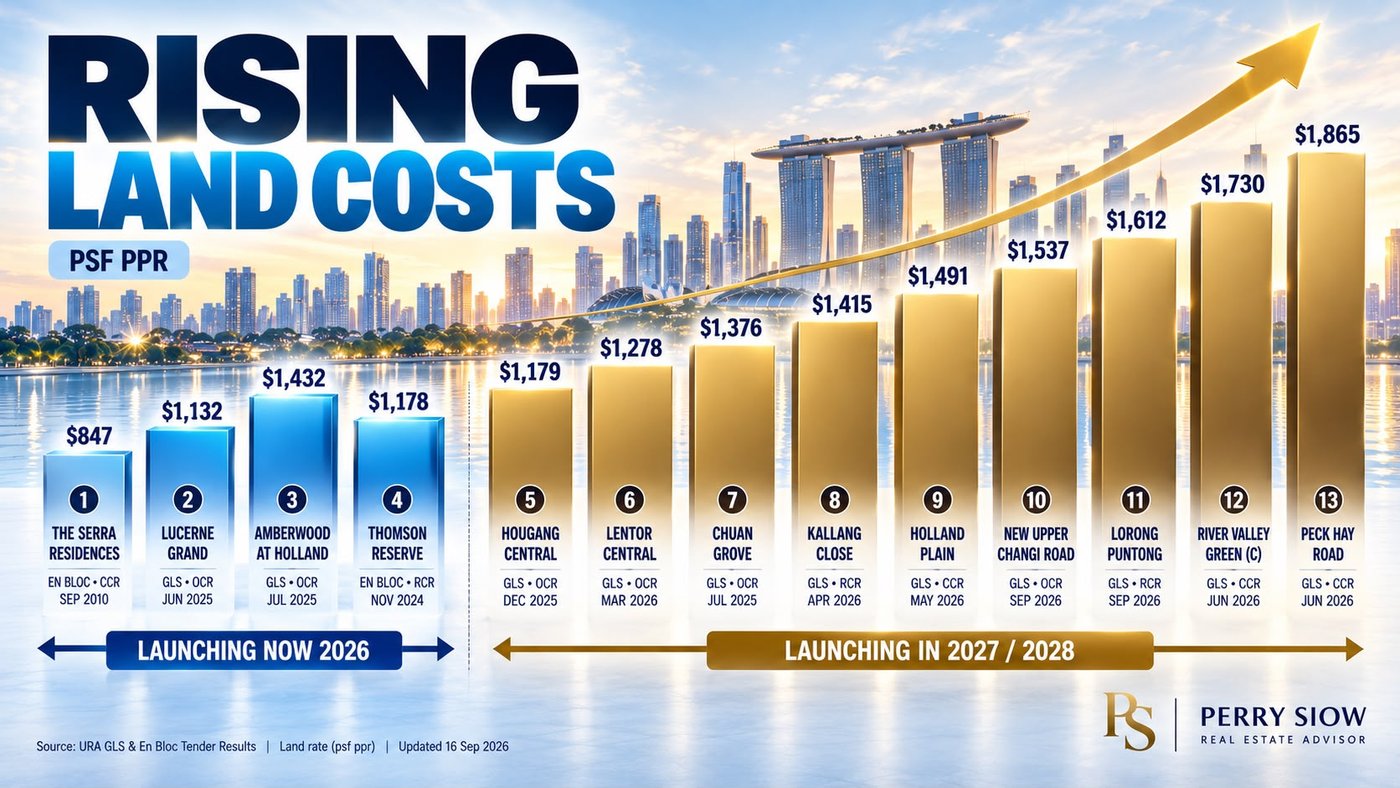
When buyers think about prices, they look at mortgage rates first. Developers look at something else first. Land.
Land and construction are among the highest costs of any new development, and they shape the price a developer needs to charge when the project finally launches. Some recent land bids, for projects that will only launch in 2027 or 2028, have come in at higher land rates than sites bought in 2024 or 2025 for projects launching now in 2026. You can follow the latest tenders on URA’s Government Land Sales page.
Does that mean every future project will cost more? Not necessarily.
Many things decide a development’s final price. But when developers pay more for land today, it raises the benchmark they’ll need to work with when they launch tomorrow. It’s easy to miss if you’re only watching mortgage rates.
What Happens When Interest Rates Rise?
Rates do matter. When they go up, monthly repayments rise and borrowing power shrinks. Some buyers wait, some trim their budget, and some look at a different type of home altogether.
But rates are usually raised to tackle inflation, and inflation also pushes up the cost of land, construction and labour over time.
So, these two forces end up pulling in different directions.
Higher rates squeeze what buyers can afford, while the cost of building new homes may be climbing at the same time. That’s why “rates up, prices down” is too simple a rule to live by.
Should You Wait for Interest Rates to Fall?
Here’s a cycle I’ve watched for over 20 years. When rates are high, the thinking goes, “I’ll buy once rates come down.” When rates fall, it becomes, “Let me wait and see if prices drop further.” And when prices start moving again, it turns into, “Should I have bought earlier?”
There’s rarely a moment when everything looks perfect, which is why I’ve approached it differently with many clients.
We accept that rates will move higher this year and perhaps lower next, and that we can look at refinancing if better loan packages come along. Instead of chasing the perfect rate, we focus on the two things we can actually control. When we buy, and what we pay.
Why Your Entry Price Matters
Think about someone who bought in 2018 or 2022. At that time, there were plenty of reasons to wait, from rising rates to economic uncertainty. Looking back, the bigger question probably isn’t whether their mortgage rate went up or down for a while. It’s what price they paid, and which property they chose.
That’s the key difference. Your interest rate can change many times over the life of a loan. Your purchase price is fixed the day you buy.
A simple illustration
Imagine the price of the same three-bedroom home at ten-year intervals.
| Year | Illustrative entry price |
|---|---|
| 2006 | S$1.3 million |
| 2016 | S$1.7 million |
| 2026 | S$2 million |
Over those 20 years, rates would have risen and fallen many times, and the owner could have refinanced whenever a better deal came along. But once the market sets a new price benchmark, it’s very hard to go back to what homes cost ten or 20 years earlier. That’s especially true in Singapore, where land is scarce, and land and construction costs have generally risen over the long run.
So, What Should You Look At?
Instead of asking “Will prices fall because rates went up?”, it helps to look at several things together.
- Interest rates affect your monthly repayments and how much you can borrow.
- Population and household changes drive the need for homes.
- Government measures keep borrowing and speculation in check.
- Land and construction costs shape the price of new launches.
- Your entry price decides much of how the purchase works out over time.
No single factor can tell us where prices go next.
You First, Property Second

Everything above is about the market. But the first question I ask anyone who comes to me is about them. Why do you want to make this move? Is it for your growing family, for investment, or to be near the right school?
And sometimes the honest answer is “don’t buy yet”. If buying now would stretch you too thin, I’ll tell you to hold off and build up your reserve fund first. A good property bought with no breathing room isn’t a good decision for your family.
There’s no rush. The aim is to build your net worth steadily, not to time the market perfectly.
To Sum It All Up….
Nobody can say Singapore property prices will never correct. There will always be economic cycles, surprises and shifts in the market.
But history gives us a useful perspective. Through financial crises, global shocks, Covid, rising rates and cooling measures, private property prices have kept trending upwards over the longer term.
That doesn’t mean prices will always rise. It means we should be careful about letting one factor, like interest rates, decide everything for us.
So if you’re weighing whether to buy, sell or hold, I wouldn’t look at interest rates alone. I’d ask four questions.
- What is the property really worth?
- What price are you entering at?
- What will the financing cost you?
- Would it still work for your family if rates changed?
Rates will rise and fall. Markets will go through their cycles. But the price you pay is the one thing you can’t change afterwards.
My sons still describe my job as “talking about houses”. I believe it’s what I do for a living.
If you’d like to talk through your own numbers, I’m always happy to sit down over a kopi (on you). No pressure, just a clearer picture.