
From One-Million to Two: Where Are HDB Prices Heading?
When I started in property back in 2000, a million-dollar HDB flat would have sounded like a coffee shop joke. Today, it’s a regular headline.
So the question I’m hearing more and more is this one. Where could HDB prices go from here? Could some flats eventually reach S$2 million?
Honestly, nobody knows yet. But the changes happening in the HDB resale market are worth a closer look, especially if you own a flat or are thinking about your family’s next move.
The Rise of the Million-Dollar Flat
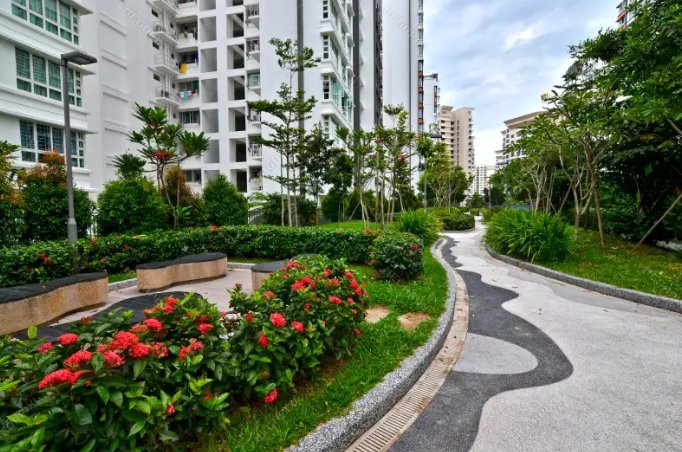
The growth has been incredible. In 2012, only two HDB flats in the whole of Singapore sold for S$1 million or more. But after that?
| Year | $1M+ HDB Transactions |
|---|---|
| 2012 | 2 |
| 2021 | 259 |
| 2022 | 369 |
| 2023 | 469 |
| 2024 | 1,035 |
| 2025 | 1,594 |
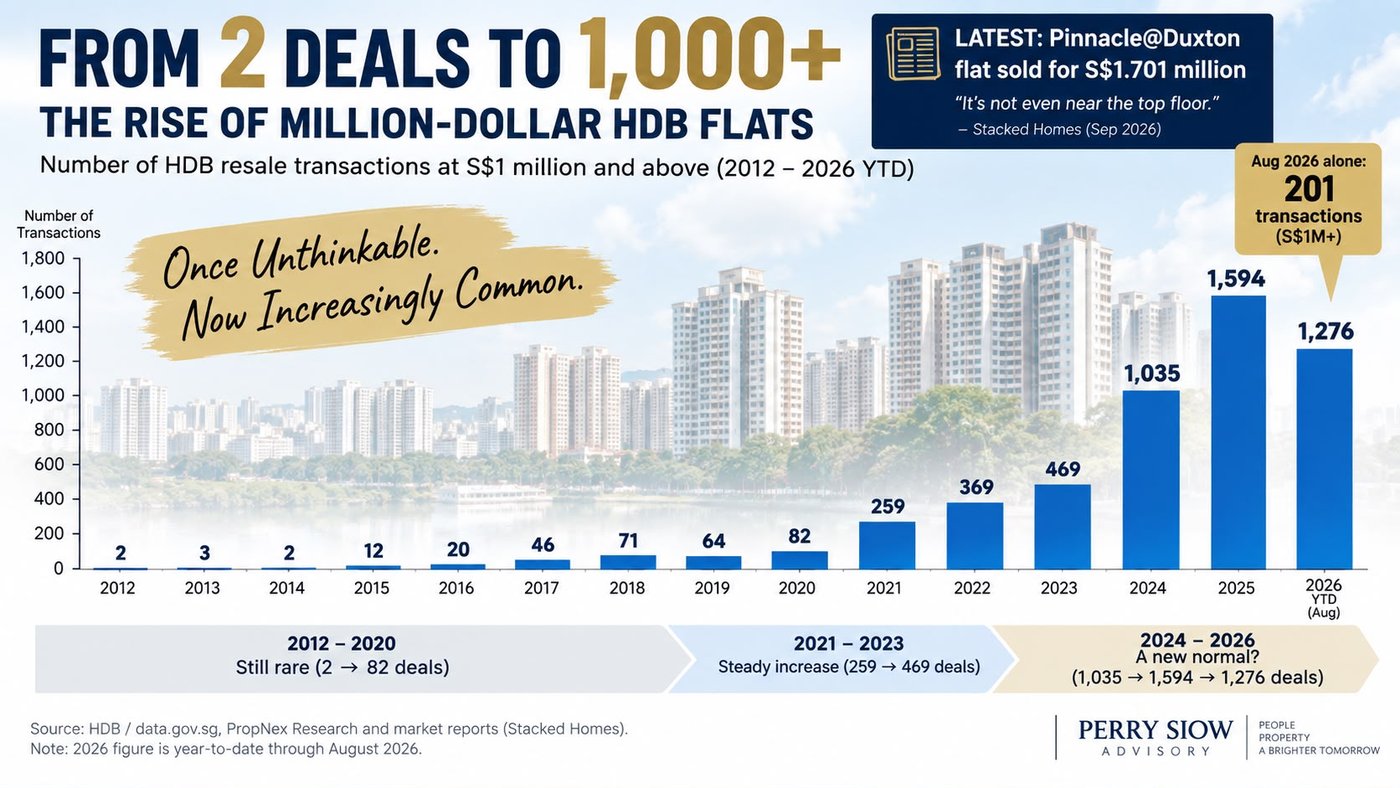
Then, this year in August 2026 alone, 201 million-dollar flats changed hands, a new monthly record. That’s a very different market from the one we saw in 2012. If you’d like to check the deals yourself, HDB publishes every resale transaction on data.gov.sg.
One recent sale is particularly impressive. A flat at Pinnacle@Duxton has just been sold for a whopping 1.7 million. At these prices, the S$2 million HDB flat is no longer a question of “if”.
It’s a question of “when”.
But is Every HDB Flat Heading for S$2 million?
Not at all. Million-dollar deals don’t mean every HDB flat is suddenly worth a million.
These sales are concentrated in a small part of the market. They tend to be larger, newer or very well-located flats, especially in mature estates with good transport links, plenty of amenities and limited supply.
So the real story isn’t simply “HDB prices are going up”. It’s that certain flats have qualities buyers will pay a real premium for.
Location matters. Size matters. The remaining lease matters. Being near the MRT and everyday conveniences matters. And when supply is tight, all of these become even more valuable.
That’s why the headline count of million-dollar deals only tells part of the story. Most families buying and selling HDB flats are doing so at very different price points.
A New Kind of Buyer

Another development could make this segment even more interesting.
In July 2026, HDB removed the 15-month wait-out period for private property owners buying a non-subsidised HDB resale flat without an HDB loan. To put it simply, people who own (or recently sold) a private home no longer have to wait 15 months before buying a resale flat on the open market, as long as they don’t need a loan from HDB.
That potentially brings a new group of buyers into the resale market. Some will be coming from private homes with plenty of equity, and some may be looking for larger or premium flats. Prices are shaped by supply and demand, so if more buyers can afford and are willing to consider higher-priced resale flats, demand for certain flats could change.
There’s already an early sign of this. PropertyGuru saw enquiries for HDB flats priced at S$1 million and above rise 154% in the first full week after the change.
That doesn’t mean every million-dollar flat will automatically get pricier. It means this part of the market now has access to a different pool of buyers, including some who have already built up wealth through private property.
Could We See a S$2 million HDB Flat By 2031?
This is where it gets interesting. A S$1.7 million HDB flat may still feel extraordinary today. But prices don’t move on today’s feelings. They move on what buyers are willing and able to pay in the future.
Picture this. Someone buys a flat for S$1.7 million today. After the five-year Minimum Occupation Period (MOP, the time you must live in your flat before you can sell it), they’re free to sell.
What might the next buyer pay? S$1.7 million? S$1.8 million? S$1.9 million? Or S$2 million and above?
Nobody knows. The market in 2031 will depend on interest rates, inflation, incomes, housing supply, government policy and, most of all, what buyers want by then. So the S$2 million question isn’t about predicting one exact number.
It’s about understanding how price benchmarks shift over time.
Price Benchmarks Can Move
Think about what S$1 million meant in the HDB market a mere decade ago. It was unusual, to say the least. Today, more than a thousand flats can cross that line in a single year.
What once seemed exceptional can, over time, become a price buyers are used to seeing. So, ask the same question of S$2 million.
It sounds extremely high for an HDB flat today. But if certain flats keep commanding higher prices over the next few years, could S$2 million become the next benchmark for a very specific slice of the market?
To be crystal clear, this isn’t a prediction. It’s simply a question worth thinking about.
What Could This Mean For Private Property?

There’s another side to this. If some HDB flats can eventually sell for S$2 million, what might a well-located private condo be worth by then?
A condo is a different kind of home. It offers gated living, facilities, a share of the land and a different pool of buyers. That doesn’t mean private prices must rise just because HDB prices do. The two markets have different features and attract different buyers.
But they’re part of the same broader housing market. If housing prices keep moving over the next five years, it’s unlikely private property prices will simply stand still. The relationship between the two is closely intertwined, and worth watching.
It Isn’t Just About the Price
It’s tempting to fixate on whether an HDB flat will hit S$2 million. But there’s a question that matters more for most homeowners.
Are you holding the right property?
Two homes can both rise in value without having the same potential. Location, property type, size, supply, demand and who is allowed to buy it all shape how a property performs over time. Simply owning a home isn’t the whole strategy. Which home you own matters just as much.
Is It Time To Think About Repositioning?

This brings us to the idea of repositioning. In plain terms, that means selling one property and moving into another that has stronger potential for the future.
If there’s a chance today to move from your current home into one that’s still undervalued and better placed to grow, it may be worth exploring. The point isn’t to sell just because prices are high, or to guess exactly what prices will be in 2031. It’s to ask whether the home you hold today is still the best one for where your family wants to be.
Now for the honest part. Repositioning isn’t right for everyone. Selling and buying come with stamp duties, agent fees, renovation costs and the very real hassle of moving the whole household.
And sometimes the numbers simply don’t work. When they don’t, you might want to stay put and keep building your reserves. For many families, holding is the right call, and that’s perfectly fine.
What I’d encourage is that you look at it properly, with real numbers, rather than letting the decision slip by. Markets keep changing. Buyer demand changes, policies change, new developments come along, and price benchmarks move. Opportunities that exist today may not be there five years from now.
Looking Ahead to 2031

Nobody can tell you whether a particular HDB flat will be worth S$2 million in 2031. I certainly can’t, and I’ve been doing this for over 20 years.
But the rise of the million-dollar flat has already changed the conversation. In 2012, just two HDB flats crossed the S$1 million mark. Today, more than a thousand can do so in a single year.
That doesn’t mean every flat is heading for S$2 million. It means it’s worth paying attention to where prices are moving, understanding why buyers are willing to pay them, and thinking about what that could mean for the wider market.
So perhaps the question isn’t “Will property prices be higher in five years?” It’s “Will I still be holding the right property five years from now?”
Because five years from now, you probably won’t be asking why prices are so high. You’ll more likely be asking why you didn’t reposition when you still had the chance.
If you’d like to sit down and look at your own numbers, I’m always happy to have that conversation. Even if the answer turns out to be “stay where you are”.